Smart Technology

ST9
Smart Technology

Smart Automative System

According to The Insurance Information Bureau (IIB), of the over 23.12 crore vehicles on the road in India as of March 31, 2019, nearly 57 per cent were uninsured. Nearly 40% of vehicles ply on Indian roads without fitness certification and emission tests. the present system there is no continuous monitoring of the above-mentioned documents. It is hard to keep track of every document for both an RTO official and vehicle owner. Our system provides systematic handling of vehicle documents in a periodic manner, so that the user and RTO can have a complete update about the insurance, emission, and fitness. This helps to bridge the gap between the RTO and the user. Once a new vehicle is purchased, the vehicle is taken to the RTO for registration. Our system will be designed and integrated with the infotainment system of the vehicle. The module will periodically check for the validity of the documents and the fastening of seat belts. If any document is found to be obsolete the user will be prompted with warnings. After a set number of warnings, the system will immobilize the vehicle. The RTO database and management system are implemented using MongoDB and Django. The module installed inside the vehicle is designed using Raspberry pi which connects to the internet using the embedded sim in the infotainment system of the vehicle. The human intervention of the transport authority would be minuscule. This means that physical checking and processing of documents and data would be reduced. This system will help to maintain the rules and regulations once implemented and will result in the disciplined action of vehicles on the road. Provides one to one attention between the government and the users in the use of the vehicles.

ST10
Smart Technology

Intellicopter – A Rescue Drone

Heavy rains and natural disasters cause accident prone areas and high-altitude regions to be highly difficult for humans to explore, and during a rescue mission in these regions, stranded humans and animals may be difficult to locate due to poor accessibility. The capability of Intellicopter to gain high attitude and capture information about any region, makes it highly viable for Rescue Missions. Intellicopter provides a bird eye’s view of any situation. Where the roads are blocked, the region is inaccessible for surveillance on foot, Intellicopter is able to survey the region effectively. The Intellicopter uses GPS Sensor in order to hold its position during flight, to aid stability. The on-board gyroscope and accelerometer add stability to the flight, and establishment of 4G connectivity between Intellicopter and Base makes it possible to stream video over greater distance easily, conveying the right kind of information required for rescue teams to operate efficiently. The Video transferred is processed to recognize the objects and feature extraction takes place. There are certain steps for preprocessing that is applies to the images; concepts of Image Conversions such as color space manipulation, segmentation, edge detection, and image morphology etc. are applied to the image to detect Humans in the frame. When a desirable object is recognized, then an appropriate alarm message containing the approximate information relating to the object can be featured on a security warning system – among other ideas, which are beyond the scope of this particular project.

ST11
Smart Technology

Automated driver-assistance systems (ADAS) for Truck

Advanced driver assistance systems (ADAS) are primarily focused on collision avoidance technologies. Advanced Driver Assistance Systems are intelligent systems that reside inside the vehicle and assist the main driver in a variety of ways. ADAS has the potential to optimize safety and efficiency in road traffic. ADAS uses sensors in the vehicle to perceive the world around it, and then either provides information to the driver or takes automatic action based on what it perceives. These systems may be used to provide vital information about Objects ahead, Blind spots, lane deviation. These systems are also used to judge the fatigue and distraction of the human driver and thus make precautionary alerts or to assess the driving performance and make suggestions regarding the same. These systems can take over the control from the human on assessing any threat, perform easy tasks or difficult maneuvers. This enables exchange of information for better vision, localization, planning and decision making of the vehicles.

ST12
Smart Technology

Under Water image enhancement

Visually guided Autonomous Underwater Vehicles and ROVs (Remotely Operated Vehicles) are widely used in important applications such as the monitoring of marine species migration and coral reefs, inspection of submarine cables and wreckage, underwater scene analysis, seabed mapping, human robot collaboration and more. Cameras onboard autonomous and remotely operated vehicles can capture high resolution images to map the seafloor. The raw images retrieved are affected by factors such as light refraction and absorption, suspended particles in the water, and colour distortion, resulting in noisy and distorted images. Due to serious degeneration, it is hard to recover the realistic colour and appearance of underwater images, while colour and appearance are crucial for underwater vision tasks, Thereby developing an effective solution for underwater object recognition with an effective enhancement model for these images is desirable.

ST13
Smart Technology

Plug and Play cubicles

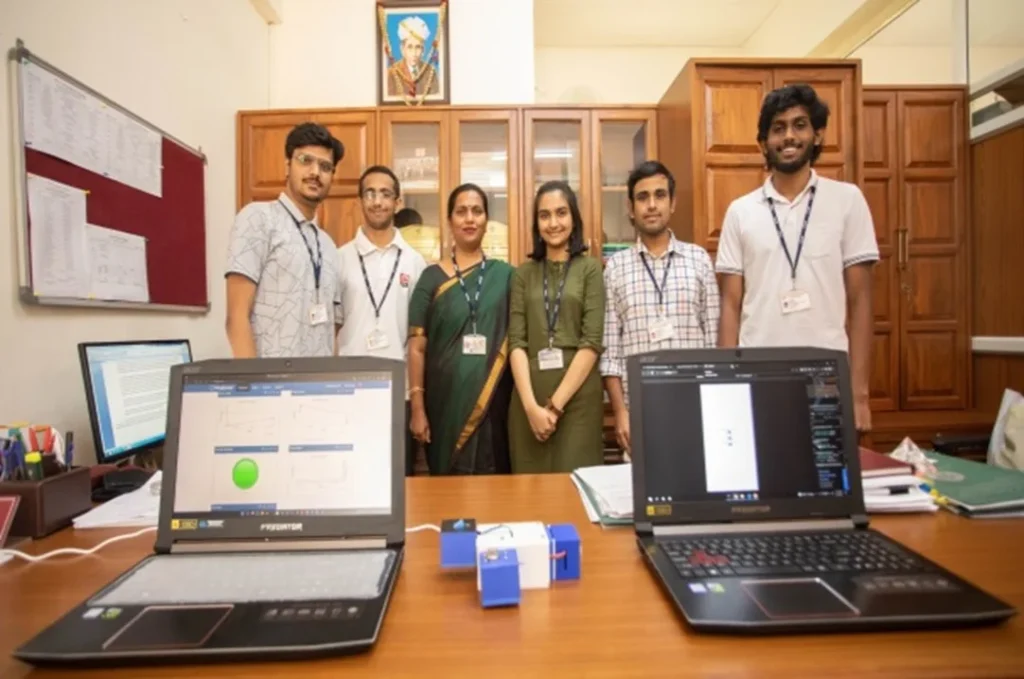
Plug and play cubicles is a project known for it’s unique, cost-effective, reusable, and compact design. It contains the main hub, a central cuboids containing raspberry pi around which sensors can be ‘plugged’ in. Any sensor can be made functional by just plugging into the main cubicle. The uniqueness is its flexibility to adapt too many sensors which is achieved through its design. The project contains a mobile application which can control the sensors that are to be activated. Currently, our project detects gas and alerts the user, detects motion, calculates the temperature and humidity. The collected data is displayed on a platform called ‘thingspeak’ in the form of a GUI and can be viewed on the phone as well.

ST14
Smart Technology

IoT based Smart Farming

Agriculture is the most important profession in India. Agriculture is the source of livelihood for most Indians of rural origin. Smart irrigation contributes to the development of agricultural countries. In India, agriculture accounts for 16% of GDP and 10% of exports. The main goal of this project is to develop an automated irrigation system using a Node MCU board that can be remotely monitored over the internet from website. Currently conventional pump switches are located in different parts of the agriculture land which makes it difficult for the user to go near them to operate and physically present on those areas even more difficult for elderly or physically challenged people to do so. Controlled irrigation automation system provides a most modern solution for those people who want to do agriculture without physically being present there. Along with this, we use a soil sensor to detect whether the soil is dry or wet through an IOT module for watering the soil where the software is connected to the water pump.

ST5
Smart Technology

Know Your Plants

The farmers are the backbone of the country who produce crops. The farmers plant many plants, crops and take care of them till they are harvested. The problem the farmers or gardeners or botanist face is that the plants or crops are diseased. To identify the disease that crop or plant has and to treat the disease with appropriate fertilizers, pesticides, the environment in which the crop or plant must be grown in is also necessary to be known before planting, the parameters like temperature, humidity etc. These problems can be solved using Know Your Plant. Know your plant is a mobile crop advisory app for farmers, extension workers and gardeners using which you can monitor your crop and plant growth. Know your plant uses farm level data to predict ideal growth conditions and resource requirements and notify farmers to take informed decisions, below the soil parameters, crop stage, crop growth. Know your plant provides real-time insight into daily progress of your crops and activities, manages sales, expenses and cash flow to ensure the health of your finances.

ST6
Smart Technology

Face recognition with anti-spoofing

Face recognition has been one of the most interesting and important research field in the past two decades. The reasons come from the need of automatic recognition and surveillance systems, the interest in human visual system on face recognition, and the design of human computer interface, etc. These researches involve knowledge and researchers from disciplines such as neuroscience, psychology, computer vision, pattern recognition, image processing, and machine learning, etc. Although face liveness detection methods have been proposed to distinguish real and fake faces, they are either time-consuming, costly, or sensitive to noise and illumination and there is still no robust technique against uncontrolled practical cases which may involve different factors such as environment, software and hardware of the system etc. A facial recognition system is a technology capable of recognizing a human face, that works by pinpointing and measuring facial features from a given image. But, this face recognition can be flawed i.e., there is a possibility of face spoofing. Our project proposes a face recognition system with anti-spoofing features. A ResNet50 neural network is used to train the model for face recognition. For anti-spoofing we use eye blink detection technique for photo attack, reflection of light technique for video attack and remote photo plethysmography technique for mask attack.

ST7
Smart Technology

Sthree Raksha: Panic intimation device for women

Women are the backbone of any economy primarily shaping future of the country. As we know the present era is with equal rights, wherein both men and women are taking equal responsibility in their respective works. Hence women are giving equal competition to men in all fields. They are assigned works in both the even and odd shift. Every single day women and young girls from all walks of life are being assaulted, molested on the streets, public transport, public spaces in particular have become the territory of the hunters. Because of these reasons women can’t step out of their house. The only thought haunting in every woman’s mind is when they will be able to move freely on the street seven in odd hours without worrying about their security. In critical situations the women will not feel insecure or helpless if they have some kind of safety device with them. We propose to have a device which is the integration of multiple devices. The hardware comprises of “Smart device” which continuously communicates with an android application on the smart phone that has access to the internet. The device also ensures to provide live tracking application which helps her family and friends to be intimated about critical situations. This project comprises of a Smart Device which continuously communicate with an android application on the smart phone that has access to internet. The device also ensures to provide live tracking application which helps her family and friends to be intimated during crucial situations.

ST8
Smart Technology

Smart Ration Distribution System

The “Smart Ration Dispensing System” is an Arduino Mega 2560-based project that aims at digitising and automating the present-day ration distribution system. It aims at reducing malpractices, minimising human errors, and ensuring proper systematic distribution of the commodities without any human intervention. A public distribution system is a widely controversial system that involves corruption and illegal smuggling of goods. This happens because every task in the provisional stores involves manual work, and there are no specific “high-tech” technologies to automate the job. This project will enhance our day-today routines using technology by taking into account the various social, economic, and general aspects. The classical method involves the customer describing to the shop retailer the quantity and type of commodity required. The distributer then measures the commodity to be given to the customer manually. Our vision is to automate this process, i.e., we have an input mechanism through which the customer scans their RFID card, the pin is entered by the user and it’s verified with the entry in the database, furthermore the allotted grains are dispensed. The calibrated load cell is kept at the bottom of the dispenser, whose main purpose is to constantly measure the dispensed commodity and compare it with the value acquired from the database (say 500 gm) and the process stops when the two values match. An IR sensor is fixed to continuously check if the container is available. If so, then the commodity is dispensed; otherwise, it will wait until the container is placed. To check the presence of the commodity in the container, we also have an ultrasonic sensor fixed. If the grain falls below the threshold value, the message will be conveyed to the retailer to refill the container.

Scroll to Top